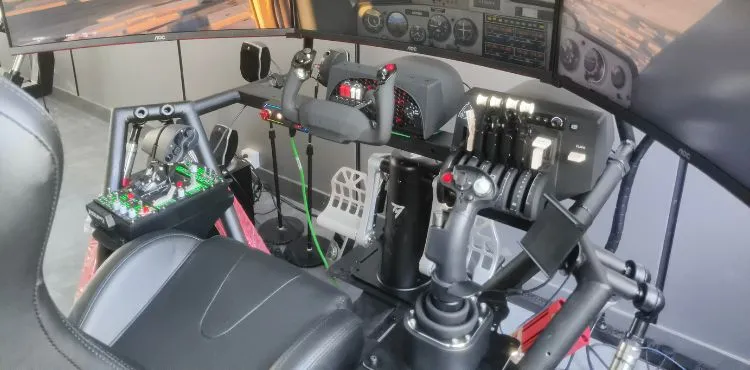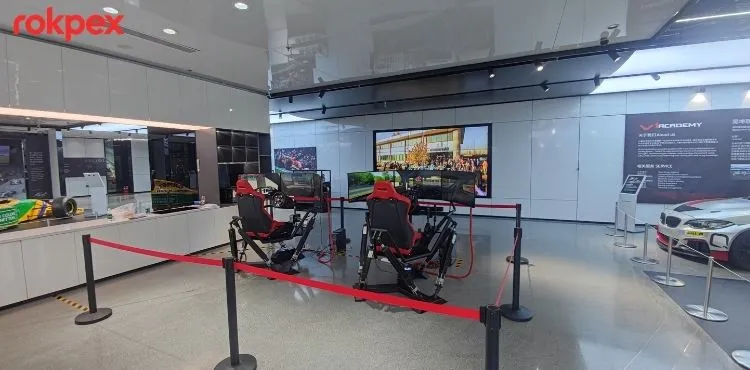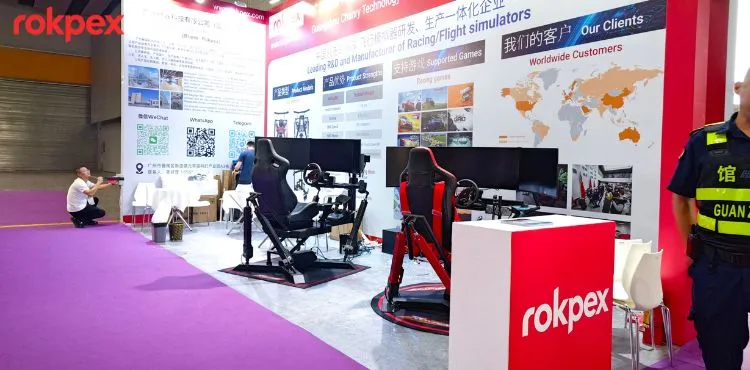
RokPex is specializing in professional racing and flight simulators based on 4DOF, and 6DOF motion platforms. Our simulators feature our proprietary integrated control system and modular design, making assembly extremely easy. With a fastest response time of just 2ms, our control system delivers quick, precise, and highly detailed motion feedback—qualities that have earned high praise from professional racing and flight enthusiasts.
We have exported to the United States, Canada, France, Switzerland, Sweden, Italy, the United Kingdom, Austria, Australia, the Philippines, Thailand, the UAE, Saudi Arabia, Lebanon, and more.
If you are exploring VR motion simulation devices on the market, you may notice a common pattern: many products deliver motion feedback that feels more like general “shaking” rather than precise, real-time dynamic responses synchronized with on-screen visuals.
This is not a matter of hardware quality, but rather a difference in control architecture. Most motion simulation devices currently available still rely on traditional control systems that were not originally designed for high-dynamic, real-time interactive scenarios.
Why Traditional Control Architectures Fall Short for Professional Simulation
The core control units in most mainstream motion simulation devices today are still based on traditional PLC (Programmable Logic Controller) architectures or similar industrial-grade control solutions.
While these technologies are proven and reliable in industrial automation—such as production lines and robotic arm controls—they have significant limitations in racing or flight simulation. In industrial settings, second-level or hundred-millisecond responses are perfectly adequate. But drivers and pilots need millisecond-level synchronization—when you take a high-speed corner in Assetto Corsa or pull up the nose in DCS World, any noticeable delay creates a disconnect between motion and visuals.
Traditional architectures have relatively long communication cycles and inherent latency in their data processing paths, making it difficult for the motion platform to accurately track rapid changes in game graphics. The resulting output tends to be more of a “general vibration” than “detailed force transmission.”
Moreover, these systems are typically closed. Users can only run games that the manufacturer has pre-installed or authorized, leaving no room to choose their preferred racing or flight software. The boundaries of the experience are defined by the vendor, not by the user.
RokPex Integrated Control System: Redesigned for Professional Simulation
To address these limitations, the RokPex team started from scratch and independently developed a brand-new integrated control system, purpose-built for high-precision, low-latency motion simulation.
Its core strengths can be summarized in three key areas:
1. Faster Response, More Precise Control
By re-architecting the signal acquisition, computation, and output chain, the RokPex system reduces command latency to a level that traditional architectures cannot match. Every pitch, roll, acceleration, and bump is synchronized with the rendered game visuals down to the millisecond.
In practice, this means drivers can clearly perceive road undulations and tire grip variations, while flight enthusiasts can feel turbulence and attitude adjustments—rather than a vague “shaking” sensation.
Reference: Traditional solutions typically operate at 80-120ms response latency; RokPex Integrated Control System achieves stable performance within 2-15ms. (Actual values may vary based on specific configurations.)
2. Fully PC-Compatible, Modular Design
The system is built around standard PC interfaces (USB/Ethernet), requiring no dedicated host machines or complex adapters. The modular hardware structure makes assembly, maintenance, and upgrades exceptionally straightforward.
Whether you are a DIY hobbyist or a commercial venue operator, you can quickly set up or expand your equipment based on your own needs, without being locked into fixed hardware bundles.
3. Fully Open Platform—Your Device, Your Rules
This is the core breakthrough in RokPex’s design philosophy.
We do not restrict your game choices. As long as a title supports Force Feedback or Telemetry Data output—including but not limited to Assetto Corsa, DiRT Rally, iRacing, Microsoft Flight Simulator, DCS World, and many others—you can directly match it and freely adjust motion parameters.
You are no longer a “user” defined by the manufacturer’s preset experience—you are the “creator” of your own simulation machine.
Side-by-Side Comparison
| Dimension | Traditional Control Solutions | RokPex Integrated Control System |
|---|---|---|
| Core Architecture | PLC or industrial controller | Self-developed real-time control platform |
| Response Latency | Higher (80-120ms range) | Lower (2-15ms range) |
| PC Compatibility | Limited, often proprietary | Fully compatible, standard interfaces |
| Game Openness | Closed / Whitelist-based | Fully open, user-defined |
| Target Positioning | Entertainment-grade | Professional racing/flight simulation |
| Assembly & Expansion | Complex, vendor-dependent | Modular, DIY-friendly |
Conclusion
The motion simulation industry is currently transitioning from “entertainment-grade” to “professional-grade” experiences. Traditional control systems have made undeniable contributions to popularizing motion-based experiences. However, for users who demand realism and control freedom, the generational gap in control systems has become an increasingly important factor.
The RokPex Integrated Control System offers a new alternative: faster response, higher precision, and—most importantly—the freedom to choose your own games.
Your simulation rig should not be a closed toy. It should be a technological extension of your driving or flying passion. RokPex simply puts the control back where it belongs—in your hands.
This article is intended for technical comparison purposes only. All products have their own market positioning and target user bases. The latency data provided are reference values based on publicly available information and laboratory tests; actual performance may vary depending on specific configurations.